
Help with the Middle Class Tax Refund
All Middle Class Tax Refund prepaid debit card accounts expired April 30, 2026, and the Middle Class Tax Refund program has ended. In accordance with the Better for Families Act of 2022, any remaining funds in the prepaid debit card accounts will be returned to the State of California General Fund. MCTR debit card recipients who would like to download their debit card transaction history must visit MCTRpayment.com and do so by 7/31/2026.
Use this page to find answers for topics related to the Middle Class Tax Refund (MCTR) payment.
MCTR program has ended
What happened to the funds on my MCTR card if I didn’t spend, transfer or have a check issued?
In accordance with the Better for Families Act of 2022, any remaining funds in the prepaid debit card accounts were returned to the State of California General Fund.
Can I open a dispute after 4/30/2026?
No.
In accordance with the Better for Families Act of 2022, your rights to the funds expired on 4/30/2026.
What if I disputed a charge but did not receive a response from Money Network?
If a cardholder opened a dispute on or before April 30, 2026, Money Network will attempt to contact them by email or USPS if more information is needed. Fraud disputes are generally resolved within 60 days. If the dispute resolution is in favor of the cardholder, a check will be issued to the cardholder within 14 days from resolution.
Identifying your payment
Your debit card
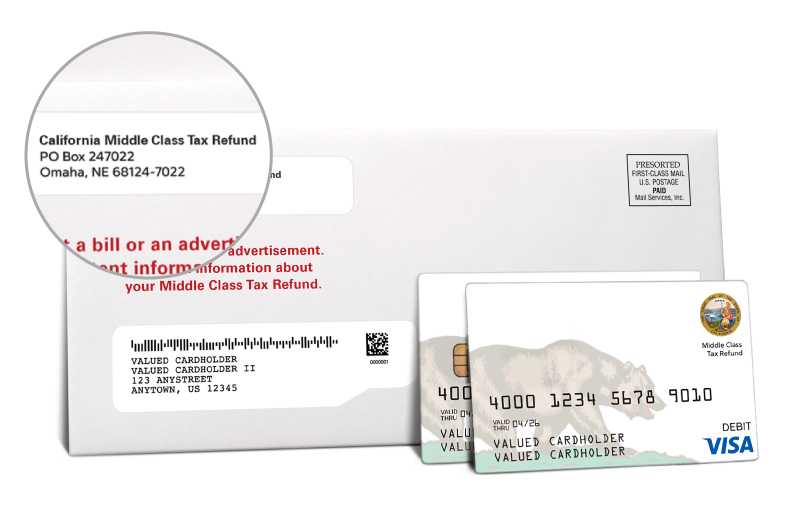
You may have received one (1) MCTR debit card per eligible 2020 tax return in an envelope such as the one below. The envelope states, “Not a bill or an advertisement. Important information about your Middle Class Tax Refund.” The card you received may or may not have an EMV chip.
Note the return address of the envelope is Omaha, NE.
Your direct deposit
You may have received a direct deposit to the bank account you received your 2020 California tax refund that states "FTB MCT REFUND MCT REFUND."
The majority of direct deposits posted to bank accounts between October 2022 and January 2023. Before contacting FTB, check your bank statements for these months.
Other eligibility and qualifications
Did not file a 2020 CA tax return
Assembly Bill (AB) 192 states that you must have already filed a tax return to qualify for the MCTR payment.
Amended 2020 CA tax return
Amending or filing your 2020 tax return after October 15, 2021 or February 15, 2022, as applicable, will not qualify taxpayers for the MCTR payment. However, FTB supports taxpayers filing true and accurate tax returns.
Household or residence
The MCTR payment was issued per tax return, not by household/residence. Two individuals in the same residence could both receive a payment individually, as long as they both qualify and did not file a joint return together in 2020.
Deceased eligible individuals
Deceased individuals that did not use the single filing status, or that claimed another person as a dependent on their 2020 tax return, may have qualified for the payment. The payment is not available for individuals deceased on the day the payment would be issued and that used a single filing status without a dependent.
Incarcerated eligible individuals
Incarcerated individuals that did not use the single filing status, or that claimed another person as a dependent on the 2020 tax return may have qualified for the payment. The payment is not available for individuals incarcerated on the day the payment would be issued and that used a single filing status without a dependent.
Married/registered domestic partner (RDP) filing separately
Married/RDP filing separately taxpayers who filed a 2020 tax return may each receive a payment if they each meet the qualifications for the MCTR payment.
Dependents
Individuals who were eligible to be claimed as a dependent in 2020 did not qualify for the MCTR payment.
Nonresidents or part-year residents
Eligible filers must have lived in California for six months or more of the 2020 tax year and had been a California resident on the date payment was issued. They must have still met the other eligibility requirements.
Use of your personal information
Money Network and New York Community Bancorp will not use your personal information for marketing purposes despite the reservation of rights in their standard privacy policy. For more information on how your personal information is being used visit mctrpayment.com.
1099-MISC income tax information
Individuals who received a California Middle Class Tax Refund (MCTR) payment of $600 or more in 2022 received a 1099-MISC for this payment. Individuals who received a MCTR payment of $600 or more in 2023 did not receive a 1099-MISC.
Taxable income
The MCTR payment is not taxable for California state income tax purposes. You do not need to claim the payment as income on your California income tax return.
The IRS delivered guidance on state tax payments on February 10, 2023, stating that Californians do not need to report the MCTR payments on their 2022 tax return, and that the IRS will not challenge the taxability of these payments for the 2022 tax year. The IRS later confirmed that Californians who received a MCTR payment in 2023 do not need to report the MCTR payments on their 2023 tax return.
Collections (offsets, withholding orders, wage garnishments, levies)
Offsets
The MCTR payments were not subject to offset for debts owed to FTB or other government agencies.
Garnishment orders
In general, the MCTR payments were not subject to garnishment orders, with the exception of orders in connection with child support, spousal support, family support, or a criminal restitution payable to victims.
If you believe your MCTR payment that was deposited to your financial institution was levied/frozen in error, contact the phone number provided by your financial institution.
Contact information
Customer support is available.
- Online
- mctrpayment.com